A note before you read. This is general patient education, not medical advice, and not a recommendation about any specific center or treatment. All claims are drawn from public OPTN / UNOS, SRTR, and government sources. Clinical authority belongs to your transplant team. Decisions about your care belong to you, the people you trust, and the professionals who know your case.
What is dual listing?
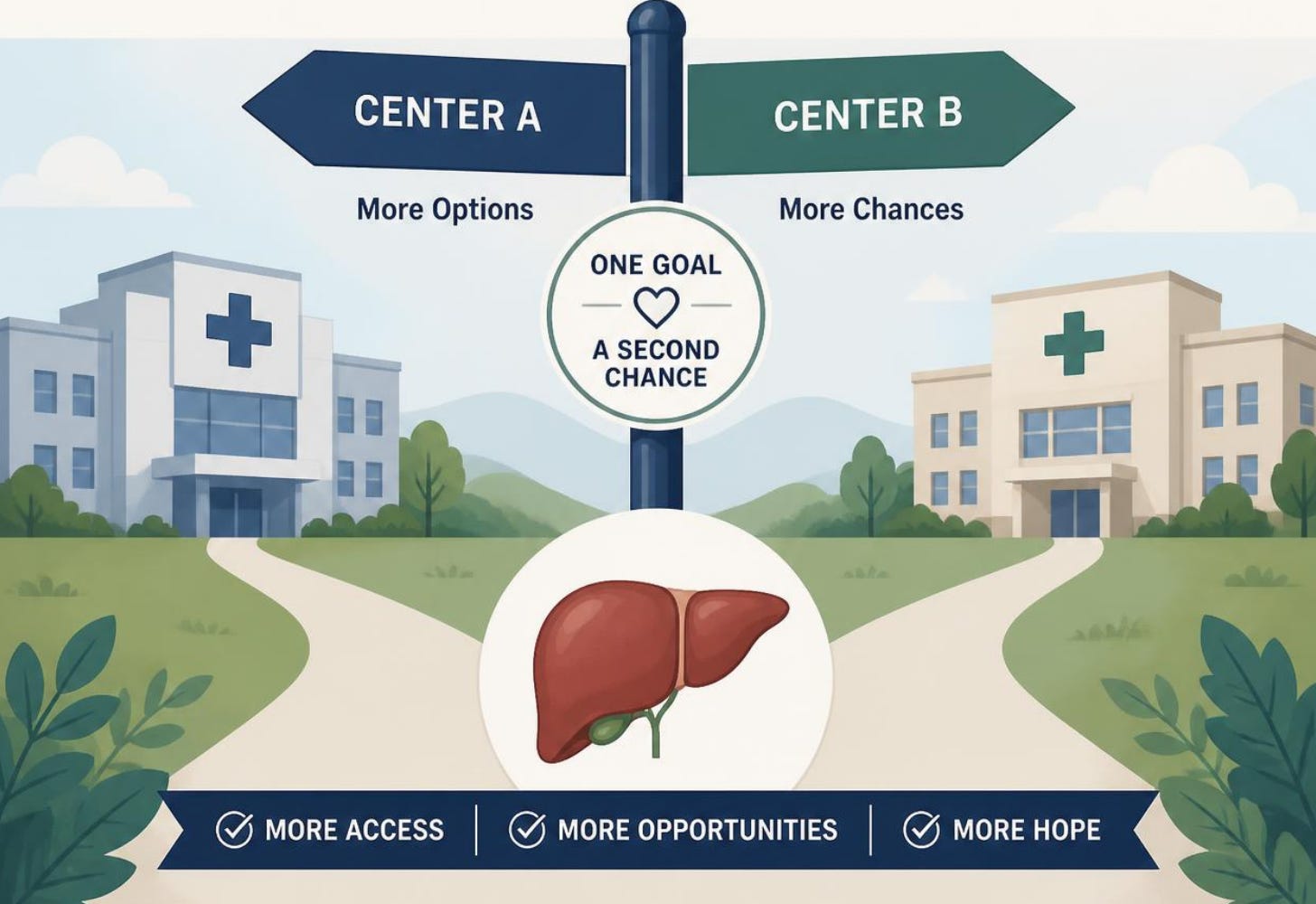
Dual listing is being registered for a transplant at more than one program at the same time. The official term is multiple listing.
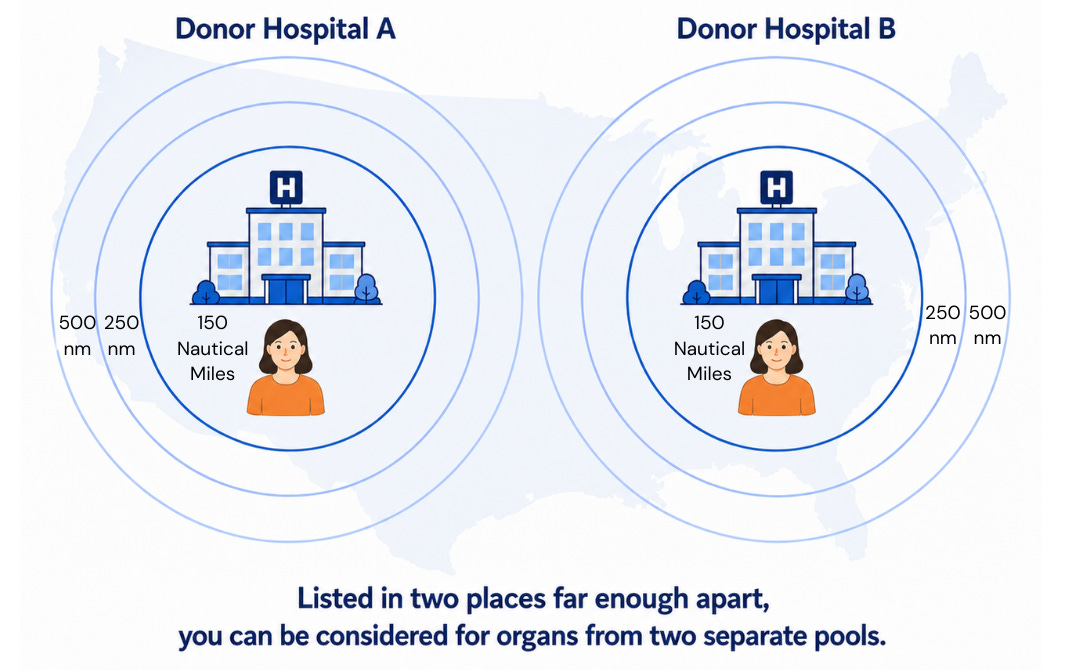
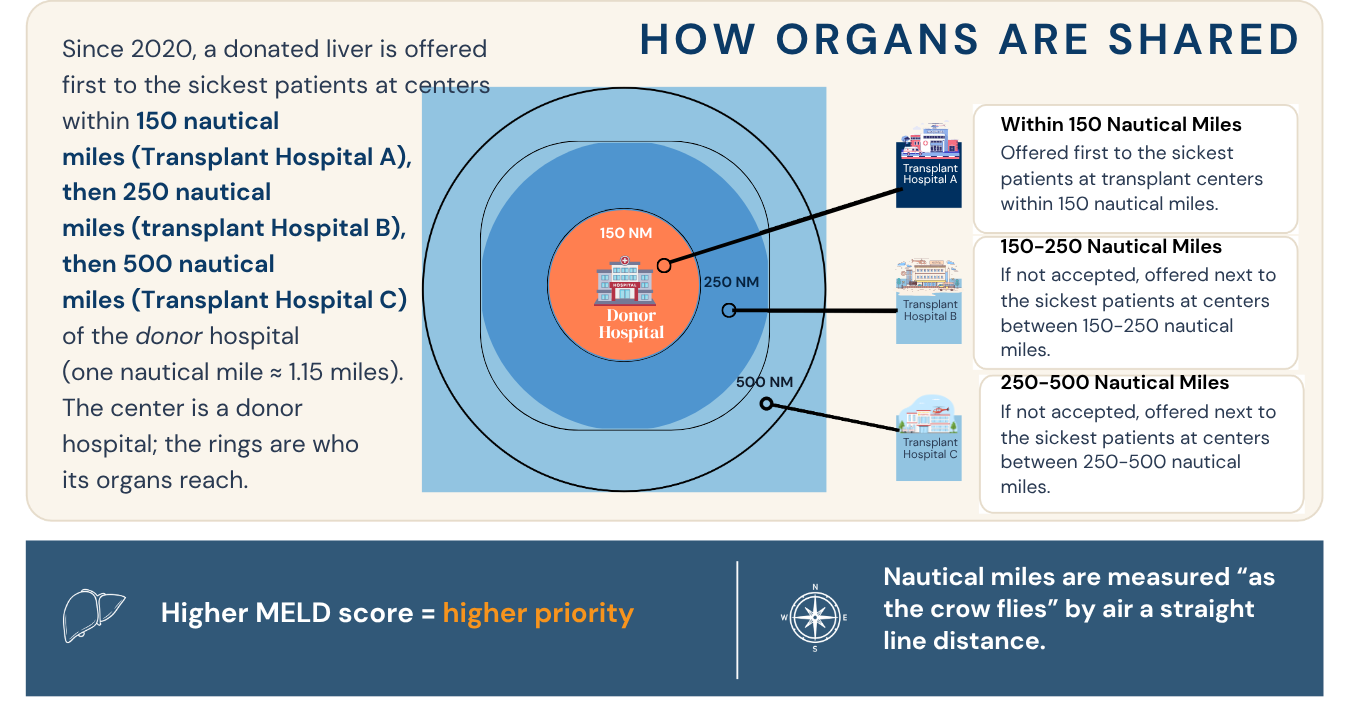
Donated livers are offered first to patients at the centers nearest the donor hospital. That means where you are listed decides which organs you can be offered. A second listing far enough away puts you near a different set of donor hospitals, and that is a second pool of organs.
Thanks for reading! Subscribe for free to receive new posts and support my work.
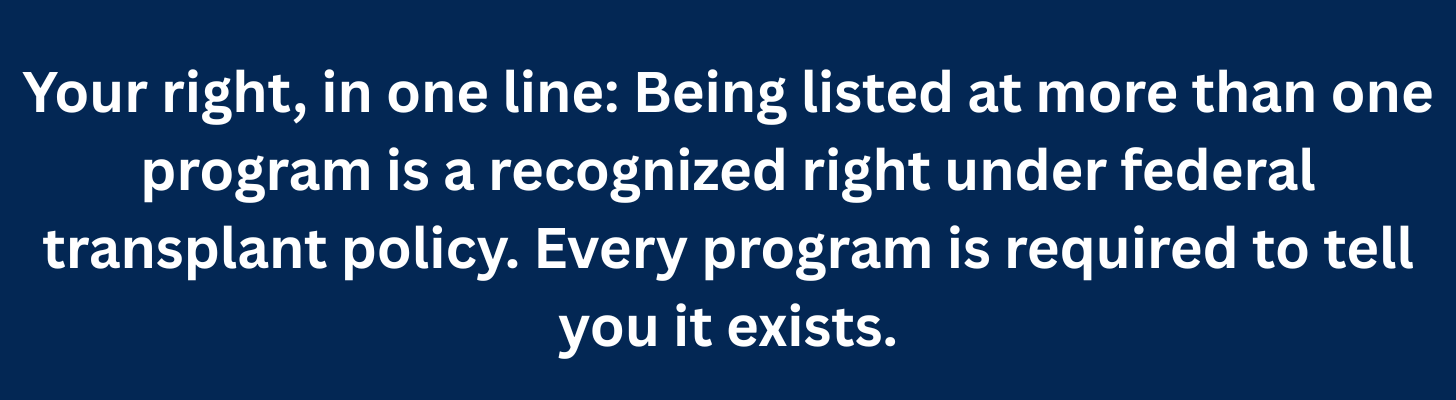
Dual listing, or multiple listing, is a recognized practice under OPTN Policy 3.4, the rules of the national transplant system run under federal contract by UNOS. A separate rule, OPTN Policy 3.2, requires every transplant program in the country to tell patients in writing that multiple listing is allowed.
Facts about dual listing
A few common beliefs get in the way before the facts do. Here is what people often hear, and what is actually true.
What people hear: “Dual listing is only for people who can afford a second round of testing out of pocket.”
What’s true: Some results carry between programs, and a second evaluation is generally billed to insurance like the rest of your transplant care. Coverage varies by plan, so confirm yours, but multiple listing is a federally recognized right for every patient.
What people hear: “My odds are the same everywhere, because it is all one national list.”
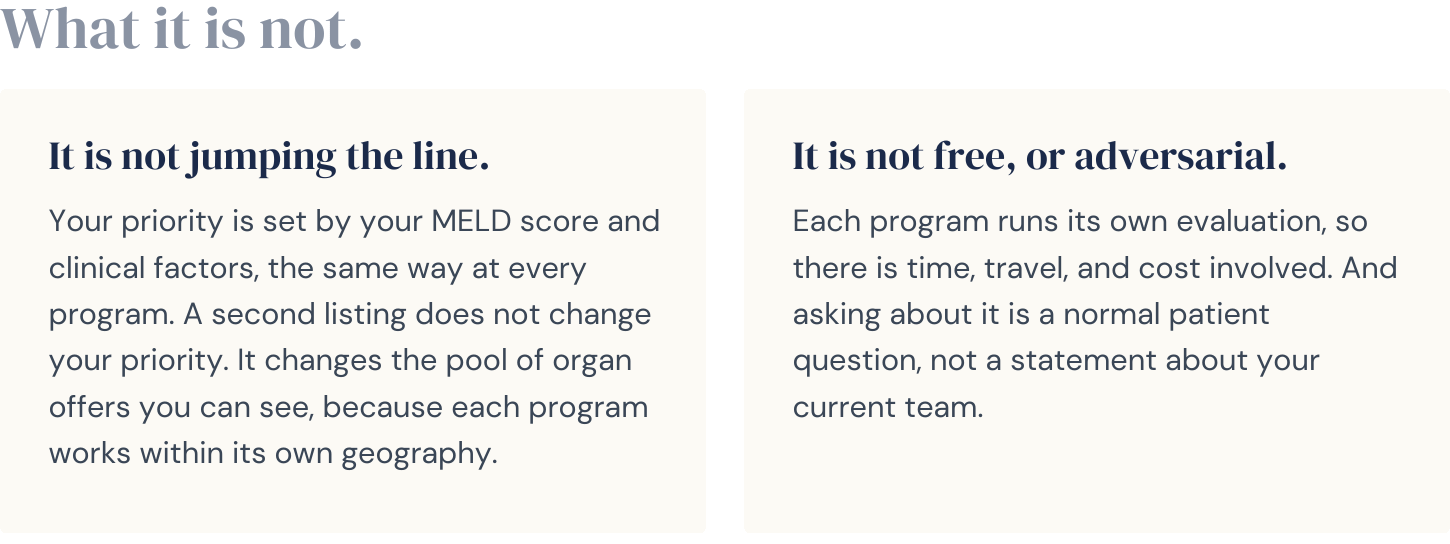
What’s true: There is one national system, but each program keeps its own waiting list and is offered organs from the donor hospitals in its area. Your MELD score sets your rank; where you are listed sets which offers you can see. The same score can mean a different wait in a different place.
What people hear: “You have to live within six to eight hours of the transplant hospital.”
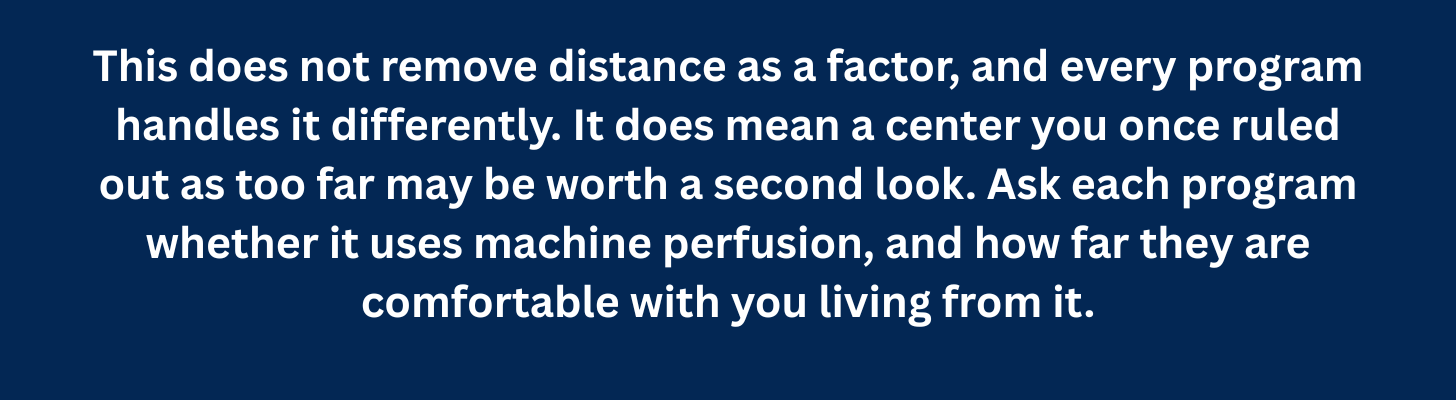
What’s true: That guidance came from a time when a donor liver could only be kept on ice for a short window, usually 6–8 hours. Machine perfusion, such as TransMedics and OrganOx metra, cleared by the FDA in September 2025, keeps a liver working outside the body for much longer. Every program sets its own distance expectation, so ask each one how far you can live from them.
What people hear: “Travel expenses are completely out of pocket.”
What’s true: Today there are many financial programs that can help with travel costs. Insurance plans will often cover medical travel depending on the plan, they can either pay up front or reimburse. Some centers are making changes to help patients travel and are loosening the requirements for assistance.

What’s Changing
Liver transplants are increasing. So is need.
Liver transplants have set records for more than a decade, and 2024 was an all-time high. That progress is real.
It is also still true that not everyone reaches a transplant in time.
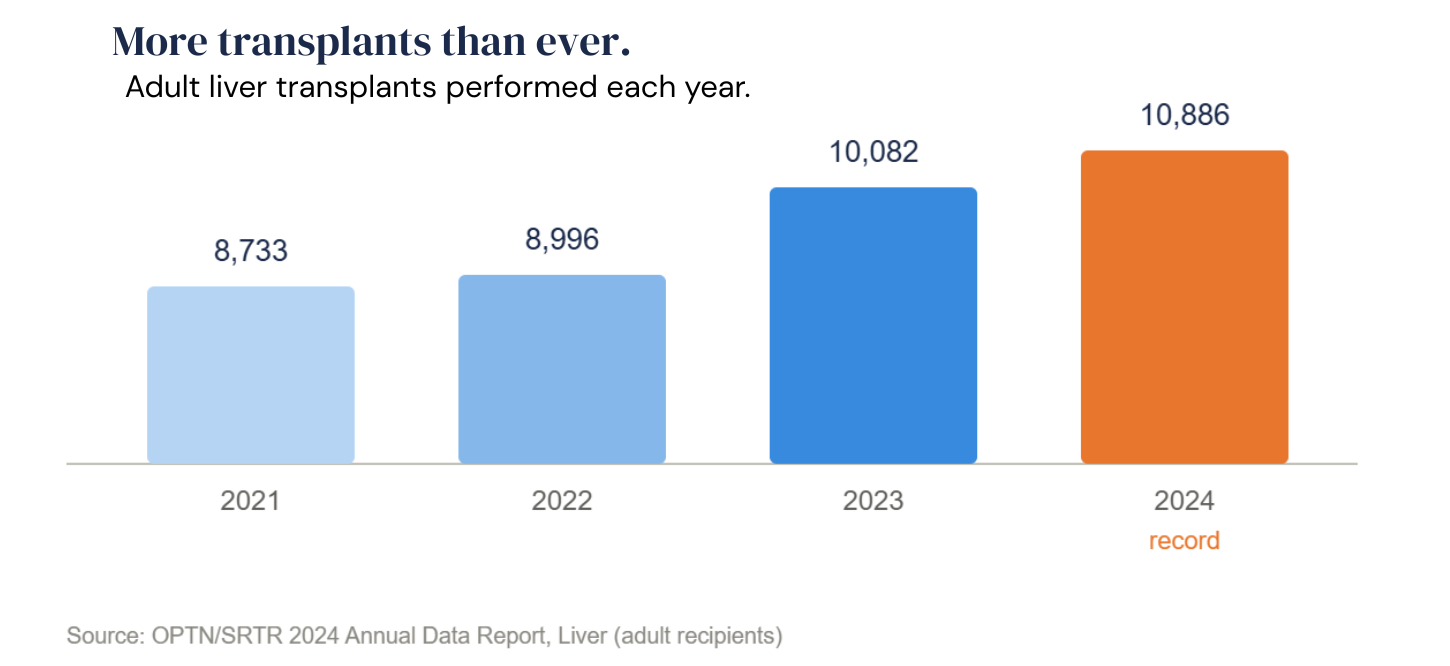
The hard part is also true: demand still outpaces supply, and in a typical recent year roughly one in eight patients were removed from the liver list because they died waiting or became too sick to transplant.
The system is improving. For the people still waiting, the choices they can make still matter.

A new technology is changing how organs are preserved
Part of the reason transplants are rising is a change in how donor livers are kept alive between the donor and the patient. For decades, a donor liver was carried on ice, and the clock ran hard against it. The longer it sat, the higher the risk of problems. Livers that could not reach a patient in time, or came from more complex donors, were often discarded.
Normothermic machine perfusion has changed this. It keeps the donor liver warm and working outside the body, rather than cold and paused on ice. Because the liver keeps functioning, it can be checked along the way and it stays viable longer than it would on ice. These devices became available outside clinical trials in late 2021, and centers adopted them quickly.
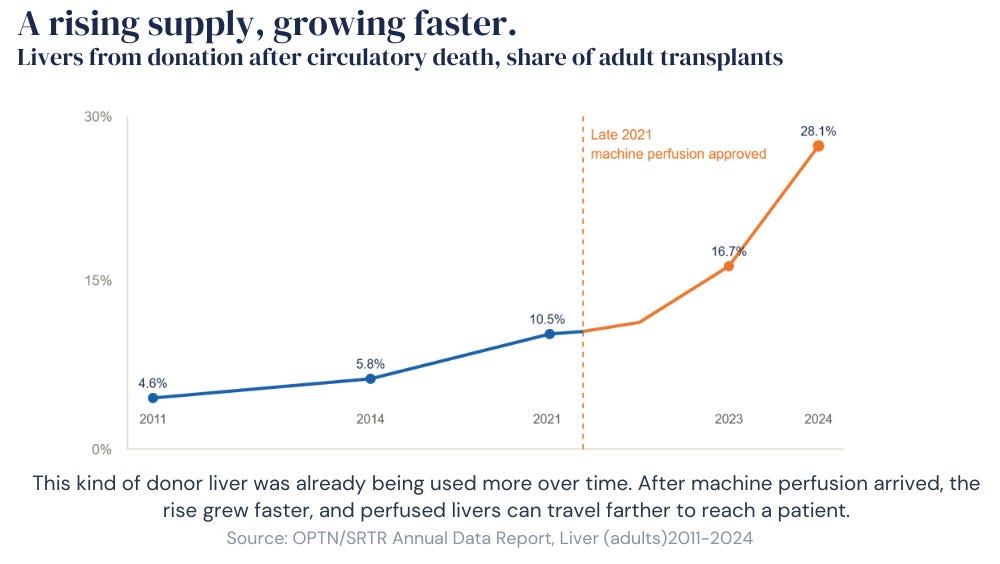
This longer window has two effects, and it is the second one that matters most to you. First, a donor liver can travel farther to reach a transplant center. Second, the time between the call and the transplant may be longer, which may mean a patient is able to live farther from a center and still get there in time.
More recently, this technology was cleared for use during air transport. A donor liver can now be carried on a chartered flight while the machine keeps it functioning and healthy. That extends its reach further still. A center halfway across the country is more reachable than it once was, both for the organ and for the patient traveling to meet it.
Why Timing Matters
When do I consider dual listing?
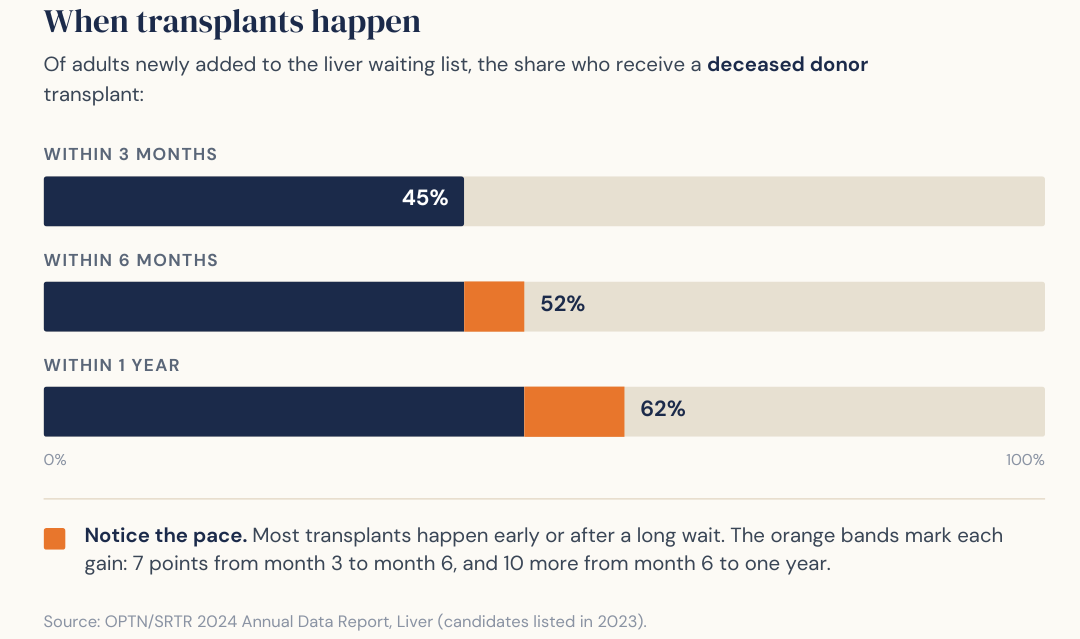
A transplant offer does not arrive on a schedule. Most people who receive one do so early. For those who do not, the wait often stretches much longer. The numbers below show the pattern: a steep climb in the first three months, then a much slower rise after that.
This is worth understanding before you are living it. If the first months pass with no offer, it does not mean something has gone wrong. It means the fast window is behind you, and the odds of a quick call have narrowed. That is the moment to widen your options, not the moment to keep waiting quietly.

What can happen while you wait?
The waiting list can feel like a single line you stand in. In practice it has moving parts. Two of them are worth checking on as time passes.
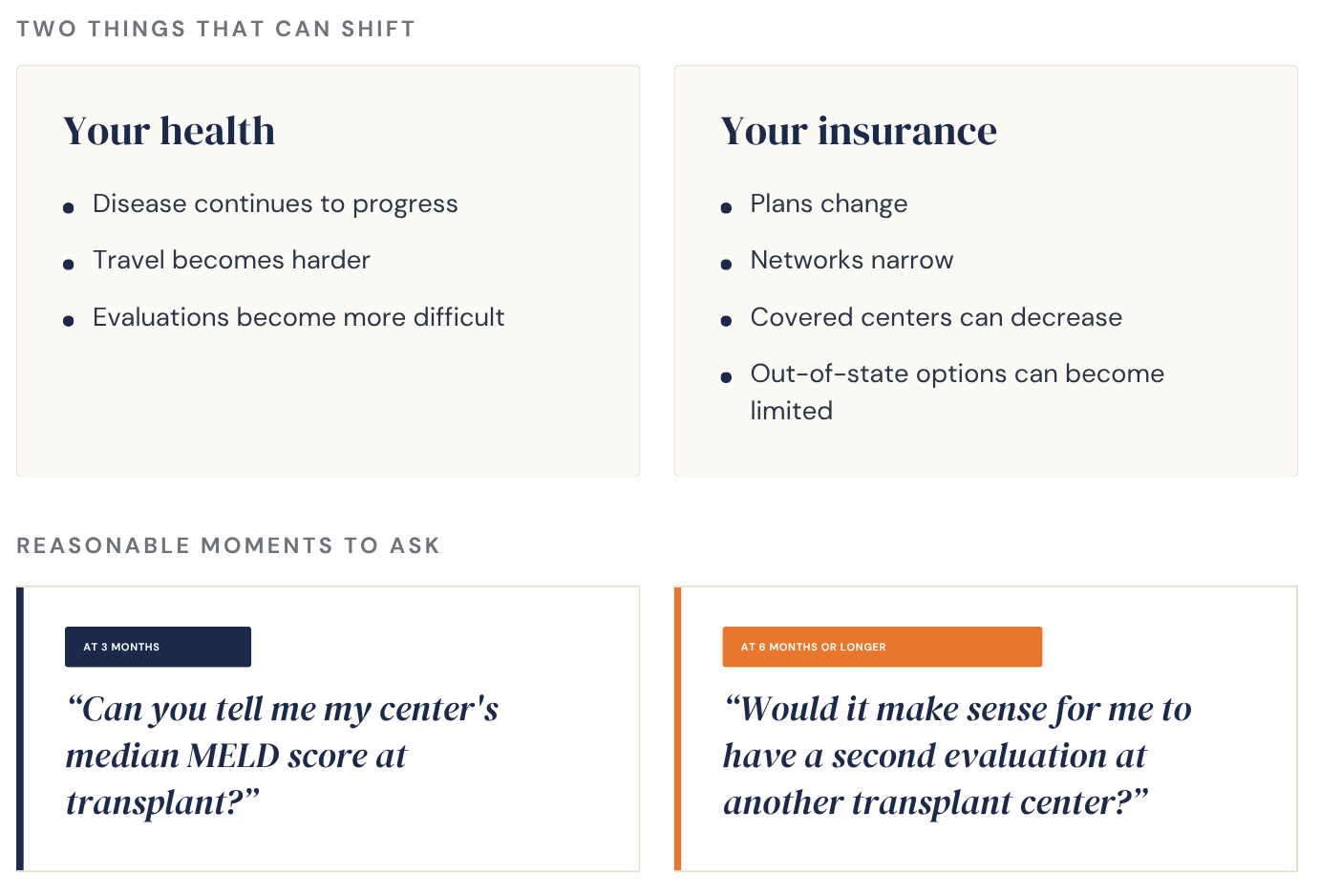

The one thing you can change
You cannot choose your MELD score. You cannot move the organs, or change where the donors are. Those are fixed.
What may be able to change is how many places you are listed.
That is all dual listing is. It does not raise your priority. It does not move you up any line. It adds a second set of organ offers, in a different place, that you cannot see from where you are listed now.
Every program draws from its own pool of donor organs, shaped by geography. Two people with the same score can wait very differently, because they are standing in different pools. And with livers now able to travel farther, a second center far enough away to have its own pool is more reachable than it used to be.

Choosing a Center
Every liver transplant program is different
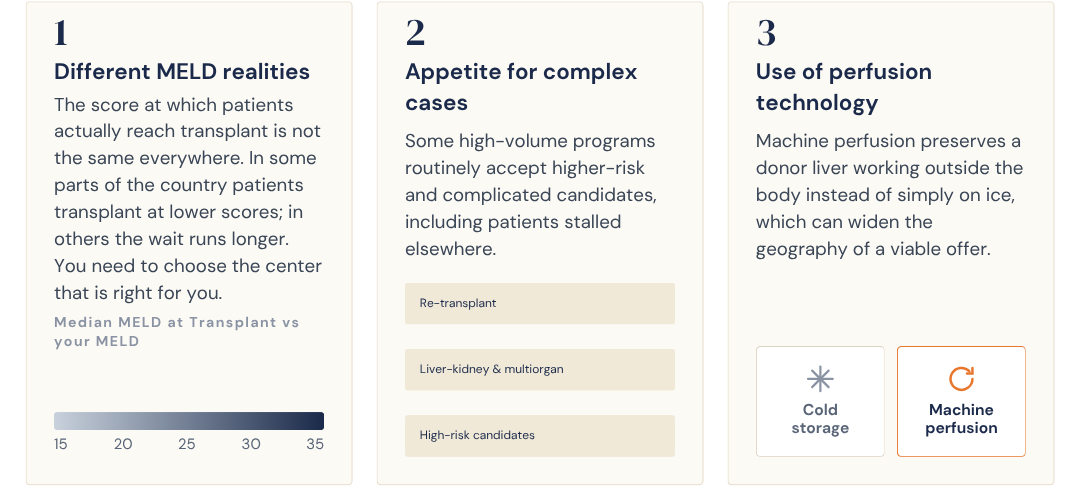
All transplant programs follow the same UNOS guidelines. Where they differ is in the patients they serve best, the MELD scores at which their patients reach transplant, the complex cases they take on, and the technology they use. None of it makes one program better. It means different programs fit different patients.

Distance is key
A second listing only helps if it draws from a different pool of donor organs than your first. It all depends on geography and a rule called acuity circles.
This is the heart of it: a second center a short drive away usually falls inside the same circles, so it sees many of the same organs. A center in a different part of the country, far enough to sit in its own set of circles, is what opens a genuinely different pool of offers.
How far is worth it? Machine perfusion is changing the answer. A distant center used to mean a hard race against the clock. Newer preservation technology, the OrganOx metra and TransMedics OCS Liver devices, keeps a donor liver working outside the body for longer. In September 2025 the FDA cleared OrganOx metra for use during chartered flights. That means centers that use it can safely reach farther, which can make a second center you would once have ruled out as “too far” a real option. Ask each program whether they use it, and how far you can live from them.

What makes a center right for you
Once a center is far enough away to make a difference, two aspects matter most.
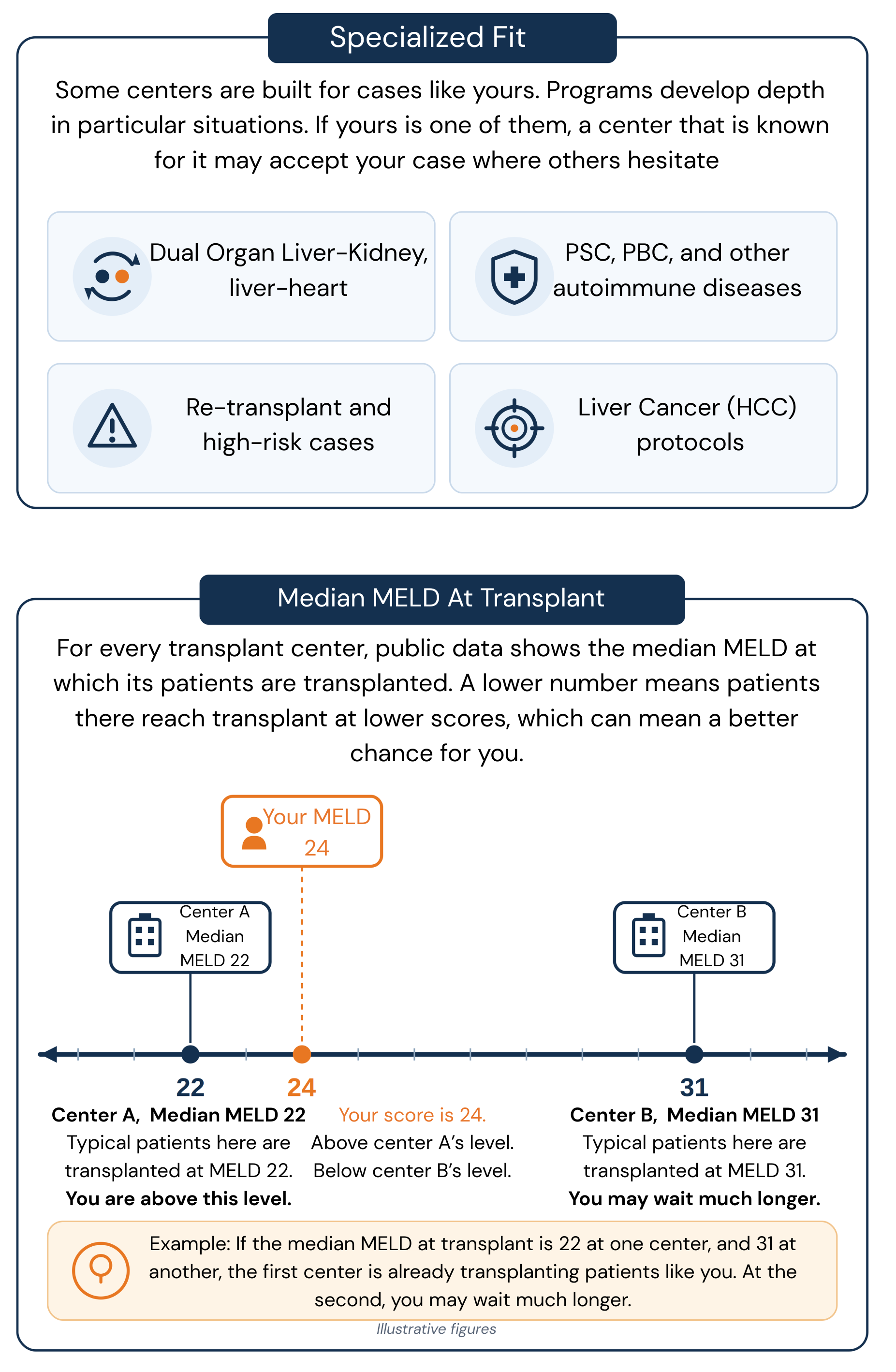
The first is fit. Programs build deep experience in particular situations, and a center that knows your kind of case may accept it when others hesitate. Some centers are built for cases like yours, dual-organ liver-kidney and liver-heart; PSC, PBC, and other autoimmune diseases; re-transplant and high-risk cases; and liver cancer (HCC) protocols.
The second is a number. A center’s median MELD at transplant is the score at which its typical patients receive a liver. If your score is at or above it, that center is already transplanting patients like you.

Making It Happen
You can start this yourself
You do not need your current team’s permission to explore a second listing. Many transplant centers accept self-referrals. That means you can contact a program directly and begin the process on your own.
A phone call to another center costs you nothing and changes nothing about your current care. It is information gathering. You are asking a program what its evaluation looks like, what insurance it accepts, and what the next step would be. Nothing about that call obligates you, and nothing about it affects your place at the center where you are listed now.
Talking with your current team is also an option, and for many people it is a good one. Your team may have useful input on which programs fit your situation. But it is not a required first step. If you would rather gather information on your own before raising it, that is a completely reasonable choice.
The path is usually three steps: (1) you call a program directly, on your own; (2) a coordinator sends you the evaluation information, or “packet”; (3) the center reviews your records and next steps, and evaluation begins.

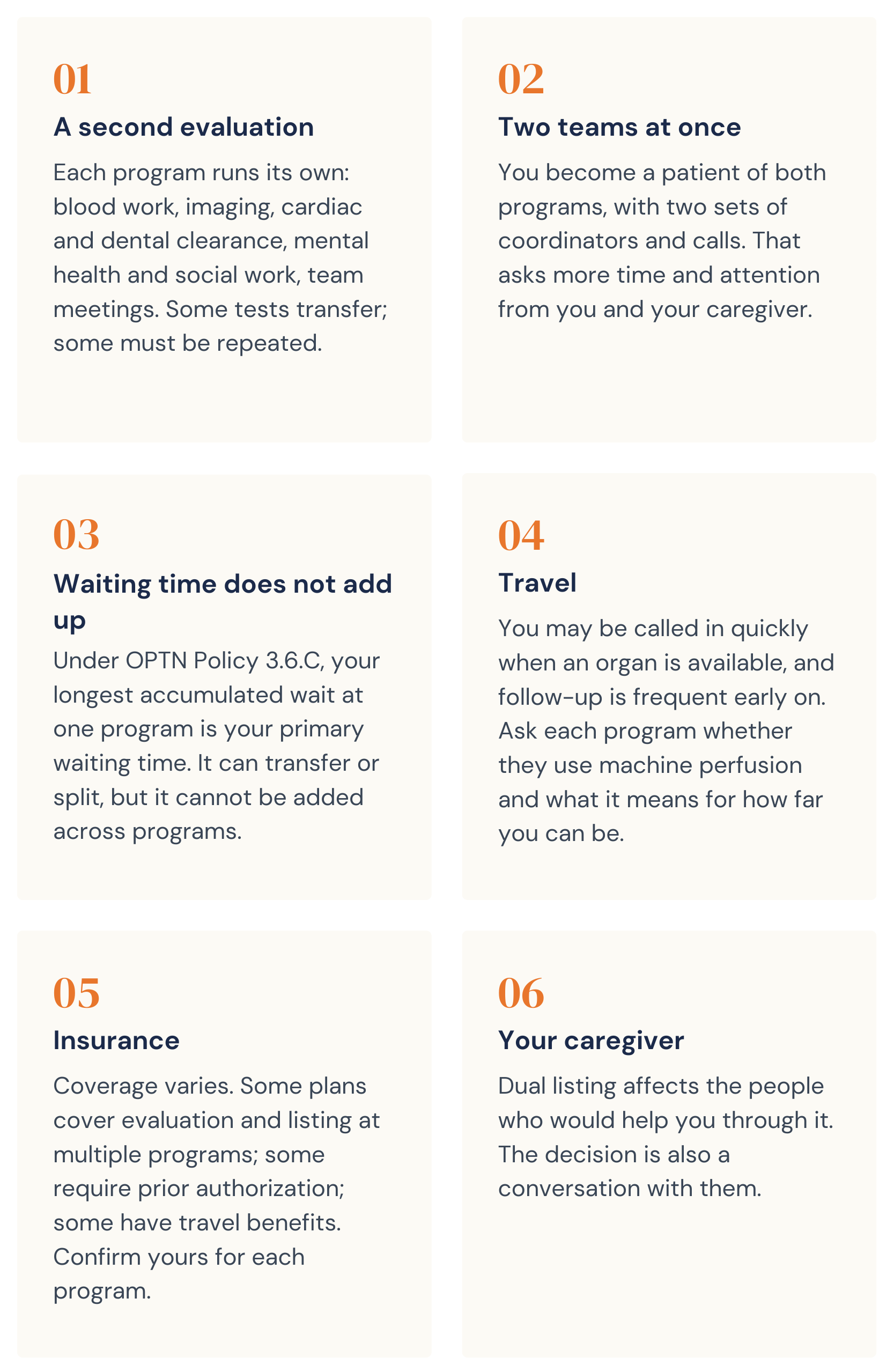
What a second listing involves
None of this is meant to discourage you or push you toward it. It is here so you can decide with full information.
How to start the conversation
These are sample openings, not scripts to follow word for word. Starting points you can make your own.
Asking another program for an evaluation:
“Hi, my name is [your name]. I am listed at [current program] and I am exploring evaluation at other programs as well. Can you tell me what your evaluation process looks like, what insurance you accept, and what the next step would be?”
Many programs have a coordinator who handles new inquiries and self-referrals. This first conversation is informational, not a commitment.
When you call your insurer, do not settle for general customer service. Ask this:
“Does my plan have a transplant case management program, and can I be assigned a transplant case manager?”
Most large insurers have one, sometimes under a specific name. That person helps coordinate approvals and can tell you which transplant centers are in your network — which matters if you are considering a second center.
Asking your insurance case manager about covered transplant centers:
“Which transplant centers are in my network, and am I covered if I list at a second center in a different part of the country?” and “Does my plan cover evaluation at more than one center, plus travel and lodging?”
Have your card in hand. Write down who you spoke with and the date, and ask for the information in writing.
Telling your current team (if you choose to):
“I am exploring evaluation at another program in addition to continuing here. This is not because I am unhappy with my care. I am trying to make the most informed decision I can.”
You can loop your team in whenever you like, before or after you have gathered information. Some people prefer to learn what other programs offer first. Either order is fine.
You Are Not Alone
Whatever you decide about dual listing, we are here. We do not recommend specific centers. We do not give medical advice. We help patients understand the system they are navigating.
A companion to this article, the Dual Listing Workbook. If you have read this far and want to act on it, the workbook turns everything above into pages you can fill in: a MELD tracker, space to compare programs side by side, travel and insurance benefit planners, and questions to bring to your team. It is free, like this guide. Find it at nationalfriends.org.
Resources worth keeping:
• Compare every U.S. liver transplant center
• Words you will hear, the full glossary
• Your right to choose your transplant center
• Talk to someone on our support line
Or call National Friends at 1-866-521-6319. We are here to help you navigate the complex system of liver transplant.
Published by Friends of the National Liver Waiting List Foundation. nationalfriends.org · support@nationalfriends.org · EIN 41-4967738 · 501(c)(3) public charity. Public information · Not medical advice.
Sources: OPTN/SRTR 2024 Annual Data Report (HRSA, 2026, srtr.hrsa.gov/adr); OPTN/SRTR 2023 Annual Data Report; UNOS year-end statistics 2024–2025 (unos.org); OPTN Policy 3.2, 3.4, 3.6.C (optn.transplant.hrsa.gov); FDA OrganOx metra authorizations, Sept 2025; SRTR Program-Specific Reports (srtr.org).
Thanks for reading! Subscribe for free to receive new posts and support my work.